
EDUCATION · PRACTICAL GUIDE · 21 September 2026
A six-month finish may describe the last stage of a degree. It does not tell you how much learning, transfer credit or preparation came before it.
By Kimi Brain Journal · اقرأ النسخة العربية
The most useful question behind an accelerated-degree video is not “Can somebody do this?” It is “What would this university require from me, given my actual starting point?” A returning student with relevant accepted credits and strong subject knowledge is solving a different problem from a student starting a first degree. A short completion story can be true and still be a poor forecast for another person.
1. Separate the three clocks
Write down three dates: when earlier learning began, when the university accepted the student, and when the final requirements were completed. A creator may describe only the third stage. Time spent on previous college courses, examinations, professional training, transcript evaluation and application work still belongs to the broader educational journey.
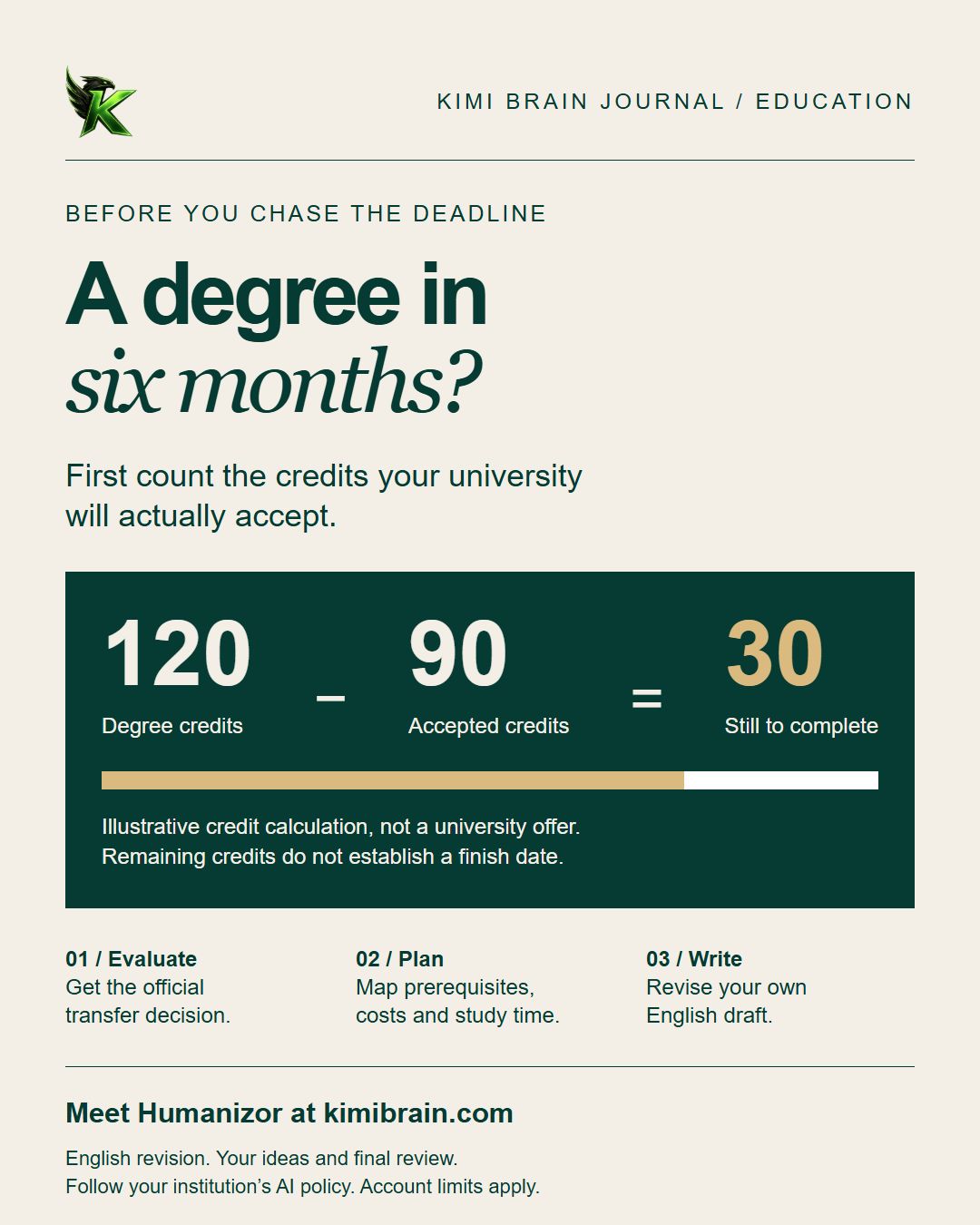
For an illustrative 120-credit degree, 90 credits accepted into the right requirements would leave 30. But “I have 90 credits” is not the same as “90 credits apply to this degree.” Some may duplicate each other, fit only elective space or fail a required grade or subject rule. Even 30 remaining credits do not specify how many months are needed: prerequisites, course availability, assessments and a capstone can control the sequence.
2. Understand the pathway before choosing the pace
A competency-based route assesses mastery rather than treating time spent in class as sufficient evidence. WGU is a university to research in this category; its official FAQ explains its model and six-month terms. A term is a billing and study period, not a promise that a whole degree fits inside it. Familiar subject matter may support faster progress, while unfamiliar material still requires learning and successful assessment.
A transfer-oriented route starts by applying eligible prior learning to a degree map. TESU's undergraduate admissions page lists transfer ceilings of 90 credits from regionally accredited community colleges and 120 from regionally accredited four-year institutions. Those ceilings are not a waiver of degree requirements. Obtain the university's actual evaluation rather than buying a course package because an online checklist says it should transfer.
3. Check residency: the word has two meanings
Academic residency concerns credits that must be earned through specified institutional offerings. It is different from living in a country or qualifying for in-state tuition. TESU's current residency policy states that it has no physical residency requirement. For specified non-military tuition plans, it generally requires 15 credits through listed TESU course formats, with an Edison Accelerate fee option described in the policy. Students bringing non-US credits also face a minimum of 30 US-institution credits for a bachelor's degree and a 90-credit non-US limit. Ask an adviser how all of these rules interact in your program.
4. Your country and intended use matter
WGU's admissions guidance generally addresses US residents, with stated overseas military and territory exceptions; it also now lists Canadian eligibility with provincial and clinical-program exclusions. A reader living in the UAE should not infer eligibility from “online.” Ask admissions before spending money on preparation.
TESU has an international application pathway, English-language evidence requirements and a process for outside evaluation of foreign transcripts. This does not establish recognition in your home country. TESU identifies MSCHE as its institutional accreditor on its accreditation page. Separately ask the authority, employer, licensing body or future university that will use your qualification whether the exact degree and study format meet its rules. Institutional accreditation and recognition for a particular purpose are different checks.
5. Price the remaining degree, not a single course
Prepare a budget with tuition, application and evaluation charges, materials, examinations, transcript delivery, graduation charges and any applicable residency-waiver fee. Add a slower-progress scenario. A path that needs an extra term can change the total considerably.
As a dated illustration, TESU lists an out-of-state undergraduate per-credit rate of US$584, effective August 2026; its international tuition page generally directs overseas students to the out-of-state rate. At that rate, 30 credits taken on a per-credit basis would be US$17,520 in tuition alone. This is arithmetic, not a full-degree quote or the cheapest available plan. It excludes earlier learning, fees and materials, and other tuition arrangements may differ. Confirm your classification and written estimate using the current rate table and international rules.
6. Build a learning workflow with Kimi Brain
Disclosure: Kimi Brain Journal is affiliated with Kimi Brain. The following is a proposed study workflow, not a claim that our tools accelerate university credit or a reported product test.
- Clarify the assignment. Where Kimi Brain Chat is available in your account and your course permits it, provide non-sensitive assignment instructions and ask: “Turn this task into a checklist. Separate the command word, required evidence and formatting rules. Flag anything the instructions do not specify.” Check the checklist against the original.
- Do the learning and write. Read the assigned sources, make notes with page references and draft your own argument. A chat explanation is a starting point to verify, not a source to cite as evidence.
- Revise English deliberately. Explore Humanizor for revision of your own English draft. It supports English only. Compare every revised sentence with your original for altered qualifications, numbers, citations and meaning.
- Keep authorship and review. Save the original and edited versions. Follow the institution's AI-use and disclosure rules; if this use is prohibited, revise manually. Account access and usage limits apply.
For example, “The study suggests a possible association” must not become “The study proves the cause.” A smoother sentence that changes the evidence is a worse academic sentence. Your final review matters more than sounding polished.
A decision you can make this week
Gather transcripts, select one exact program and request a written remaining-requirements map. Ask which credits apply, what must be taken through the university, which courses depend on others, what your country of residence changes and what a slower finish would cost. If the answers are not available, label the six-month plan an untested target. A credible route can be flexible and ambitious without promising the same finish date to everyone.
Explore Kimi Brain: Chat and writing tools · Our Network
Sources checked 21 September 2026. Program rules and prices can change; obtain current written guidance before enrolling.