
EDUCATION · WORKING PLAN · 21 September 2026
A one-to-two-year degree target becomes useful only when it is connected to accepted credits, an approved course sequence and hours you can actually protect each week.
By Kimi Brain Journal · اقرأ النسخة العربية
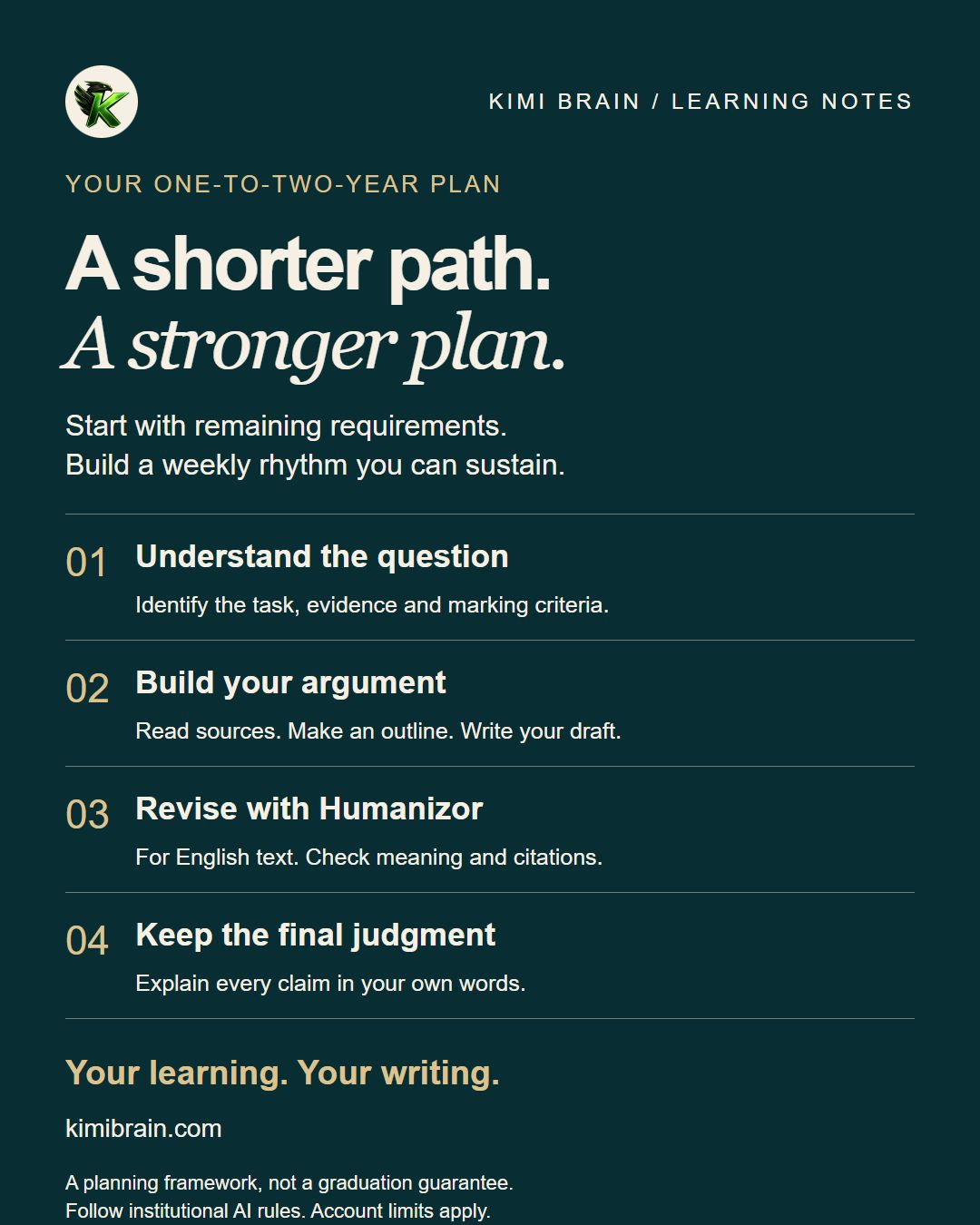
A flexible degree can be attractive to a working adult, a returning student or somebody whose earlier learning no longer fits a conventional timetable. Flexibility still needs structure. The starting point is a written list of what remains, followed by a study routine that produces evidence of learning every week. This guide supplies a planning worksheet and an original essay example; it does not report a tested graduation outcome.
1. Set the destination before the deadline
Write one sentence explaining what the qualification must enable: a particular job application, postgraduate admission, a licensing requirement or personal learning. Then verify that the exact degree, institution and delivery method will be accepted for that purpose. Do this before treating a fast finish as a benefit. For a regulated profession, general institutional accreditation may not satisfy professional requirements.
Research two different models. WGU's competency-based model uses demonstrated mastery and six-month terms. TESU offers transfer-oriented pathways and different methods of earning credit. Neither model guarantees a particular completion time. A one-year target may be a remaining-completion plan for a well-prepared transfer student; it should not be presented as the normal time for a new learner to earn an entire degree.
2. Turn the evaluation into a dependency map
Collect official transcripts and request an institution-issued evaluation. For every remaining requirement, record: course or assessment, credits, prerequisites, permitted delivery format, next availability, estimated workload and the adviser who confirmed it. Mark a prerequisite with an arrow to the course it unlocks. One unavailable prerequisite can delay several otherwise manageable subjects.
Transfer limits and residency rules are program-specific. Review WGU's transfer process or TESU's admissions instructions for the institution you are considering. Do not pay for outside courses until the university confirms how they fit. Preserve the dated written advice because partnerships and equivalencies can change.
3. Screen eligibility and total cost early
Online access does not mean worldwide admission. Check WGU's current residence restrictions and exceptions, or TESU's international admissions requirements. International applicants may need English-language evidence and external evaluation of foreign records. Check recognition with the authority or organisation that will use your degree; a university's admission decision does not settle that question.
Budget at least two scenarios: your intended pace and one that takes longer. Include tuition for every term or credit, required materials, examinations, evaluation, application, graduation and applicable residency-related charges. TESU's tuition hub distinguishes plans and international rates. Use the selected university's written estimate rather than multiplying an advertised monthly price. This planning framework has no universal total cost because the accepted credits and fee category differ by learner.
4. Test a weekly plan before projecting a year
Here is an illustrative twelve-hour week: three two-hour reading and practice blocks; one three-hour writing block; one two-hour revision block; and one hour reviewing progress and arranging the next week. The hours are a planning example, not a university workload recommendation. A laboratory, placement or demanding assessment may require much more time.
For two weeks, log what you actually finish. Record a deliverable rather than merely “studied”: solved five problems unaided, summarised a source accurately, or completed an evidence-based outline. Compare your observed pace with the university's workload guidance. If the gap is large, reduce the simultaneous load or extend the target; do not assume future weeks will all be unusually productive.
5. From an assignment question to your own essay
Disclosure: this Journal is affiliated with Kimi Brain. The following prompts are proposed examples, not captured Chat outputs or proof of improved grades. Use them only where your institution permits the assistance and the feature is available in your account.
Suppose the assignment is: “Compare two explanations for employee turnover and evaluate which is better supported by the assigned readings.” Begin with the command words. “Compare” requires a shared basis for similarities and differences. “Evaluate” requires a reasoned judgment against evidence, not two disconnected descriptions.
- Clarify with Chat. In Kimi Brain, ask: “Explain what this question asks me to do. Propose three questions I should investigate. Do not invent sources or write the final essay.” Check the explanation against the rubric.
- Create an evidence table. Read the assigned materials yourself. For each explanation, record the claim, supporting evidence, page reference and limitation. Leave missing information blank instead of accepting a plausible invented citation.
- Draft a position. Write a provisional answer and an outline: introduction, comparison by criterion, evaluation of evidence, counterargument and conclusion. Ask Chat to identify a gap in the outline, then decide whether the criticism is valid.
- Write before rewriting. Produce your own paragraphs. Keep exact quotations and source references separate from paraphrases.
- Review with Humanizor. Where permitted, use Humanizor on your English draft. It supports English only. Keep the source version and compare meaning, qualifications and citations before accepting edits. Account access and usage limits apply.
6. A revision check that protects the argument
Original illustrative sentence: “The interviews suggest that scheduling contributed to turnover, but the small sample limits generalisation.” Protect three elements: the evidence came from interviews; the claim is tentative; the sample limits wider application. Reject a revision that says scheduling “caused turnover across the industry.” Fluency cannot repair an unsupported causal claim.
Finally, explain your argument aloud without the tool. If you cannot explain a paragraph or locate its evidence, return to the reading. Follow citation and AI-disclosure requirements. If the course prohibits this workflow, use the same checklist with manual planning and revision instead.
When the plan breaks
- Credits are rejected: request the reason and update the remaining-requirements map before purchasing replacements.
- A course is unavailable: ask the adviser about an approved substitute or a revised sequence.
- Chat gives an uncertain explanation: verify against course materials or ask the instructor; do not convert uncertainty into a confident answer.
- A rewrite changes a citation or qualification: restore the source detail and review the whole sentence.
- Your pace is slower: recalculate time and cost using actual progress, not the most optimistic week.
A useful outcome is a realistic course map, a sustainable weekly schedule and an essay you understand and can defend. Kimi Brain can be part of the permitted writing workflow; the university awards credit for meeting its requirements, and the learning remains yours.
Explore Kimi Brain · Our Network
Official sources checked 21 September 2026. Confirm current program rules, eligibility, costs and institutional AI policy before acting.